
Andy Ezeani
Tuesday, May 5,2026
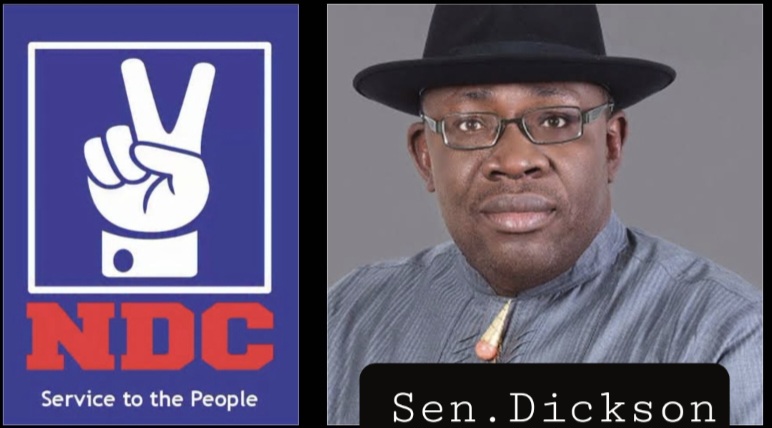
The possibility that one of the tea boys or security staff of Senator Serieke Dickson, the promoter of the National Democratic Congress (NDC) will spring up sooner than later, to claim, with a newly induced confidence, that he is the chairman of a faction of the NDC, was the subject of a discussion over the weekend.
It is instructive that no one was ready to bet, at the discussion, that such a scenario would not arise. That is where Nigerian politics is at the moment.
Should such a claim arise, Dickson would likely laugh off what initially he would dismiss as the antics of a wayward assistant. Reality will, however, dawn on him soon after, when the source of the temerity of the tea boy of yesterday becomes clearer.
Such temerity comes from what is called empowerment in the parlance of Nigerian politics. It is a prevailing phenomenin in the political arena, directed mainly, against opposition parties. Empowerment turns a lamb into a tiger overnight. It facilitates the subversion of whatever institution or system needs to be subverted.
The strategy spares no thought for enduring societal values. Tomorrow will take care of itself.
It is not yet clear if Senator Dickson and the NDC prepared themselves well for the days ahead. Once Peter Obi and Rabiu Musa Kwankwaso, leading a yet indeterminate number of former members of the beleagured African Democratic Congress (ADC), embraced the NDC, the quiet existence that had been the lot of the NDC since it was registered, practically came to an end. Senator Dickson may not have fully appreciated that the NDC is now in the centre of the vortex of the 2027 politics.
With the realignment in the political arena over the weekend, prominent members of the ADC now became NDC faithful. Among them counted the former Imo State governor, Emeka Ihedioha and Senator Aishatu Dahiru Ahmed, popularly known as Binani, a prominent figure in Adamawa politics. It will take the next few days to identify who is where.
Of course, the teaming members of the Obi loyalists, the Obidients, and the massive Kwankwaso faithful, the Kwankwasiya, simply changed address.
Less than 24 hours after Obi, Kwankwaso, and other former members of the ADC, aligned with NDC, the digital membership narrative of the ADC and the NDC was dramatically altered, according to reports. While there was a heavy traffic of members exiting ADC, a development that curiously coincided with the party’s portal announcing a temporary closure for maintenance, the NDC portal reportedly recorded a surge of new entrants.
With the prospect of a manufactured factional leader of NDC apparently far-fetched, considering that the NDC is a brand-new party that is yet to hold its national convention for the first time, a different line of ambush on the party seems to be in the offing.
Barely hours after the embrace of the NDC by Obi, Kwankwaso and their associates, reports had it that fly-by-night politicians readied themselves to be activated to initiate legal challenges, not about the authenticity of the leadership of the party, but about its registration. Indeed,there already is a case against NDC. For empowerment-searching freelancers, a new business opportunity has opened up.
According to the reports, the mercenaries angling to be empowered intend to initiate or have already initiated a legal action to challenge the process through which NDC was registered by the Independent National Electoral Commission (INEC).
Anything to muddle the water. The case is to establish that the NDC registration was faulty.
At a different time and season, this would have been dismissed as a seasonal disorientation by entities in search of survival. At the moment, in Nigeria, however, nothing is too absurd to conjecture or to be associated with the state.
How does a third party with neither loss nor claims in the existence of a registered political party challenge the process through which the party was registered? And to consider that such a vacuous challenge was not made when the new party commenced its registration process almost ten years, nor when it was registered?
Obviously, the impetus for the challenge of NDC is that specific citizens joined the party. So, the certificate of registration of the NDC from the Election Management Body needs to be examined.
Yet, for all this asininity, a matter on why and how NDC was registered may now gain currency, and a judge will possibly grant an injunction and give a hearing date in late June 2026. It may seem far-fetched for now, but watch it.
There must be a limit to the nadir to which a country can wilfully be pushed. Nigeria is already a butt of jokes on the global arena on many fronts. Enough!
The inability of the presidency to help itself by, at least, managing its thinly-veiled support for various crude subversions of opposition political parties is most unfortunate. Reacting to developments within political parties, including which politician moves to what new political party should, under normal circumstances be in the purview of the All-Progressives Congress (APC), not the Presidency.
Hounding opposition political parties and going the extra mile to constrict the political space so that President Bola Tinubu will not have viable opponents in 2027 is a most curious and detestable type of politics It sets a dangerous precedence. There is life after the Tinubu presidency, whatever its expiry date turns out to be.
The on-going absurd game of chasing major opposition candidates round and around the political space, seeking to eliminate them before the contest proper, more like children’s game of musical chair, is introducing a culture that may endure beyond 2017. Time will tell.
While welcoming the new teaming members of the NDC last weekend, Senator Dickson may have spoken too quickly when he reportedly assured them that they had come to a party where “status quo ante bellum” is not a problem to be resolved. That was one for the ADC.
Well, he needs to pray hard. Once a party has in its fold Peter Obi, obviously the biggest nightmare of the presidency, as NDC now does, then everything is on the line, including the certificate of registration of the party. Enough! This used to be a serious country.
