
Andy Ezeani
Tuesday, February 24 2026
The prospects of democracy in Nigeria have never appeared more uncertain than presently. Twenty-six years after military dictatorship ended in the country and electoral democracy was restored, neither democracy nor the people are sure of what is going on.
The fabrics of the political system seem to be unraveling precipitously.
There is, without doubt, an unmistakable turn away from where the country started out in 1999 as a vibrant multi-party democracy. A burgeoning authoritarianism is clearly at hand, with no care about popular will.
Scruples have no place in the prevailing dispensation. Subtlety, too. The law merely exists, as it seems, to be used to serve whatever purpose the powers that be desired. Institutions of the state, meanwhile, have become nothing more than ready tools to be used by politicians. There is every reason to worry, not just for the moment but for the future, because tomorrow will come. Inevitably.
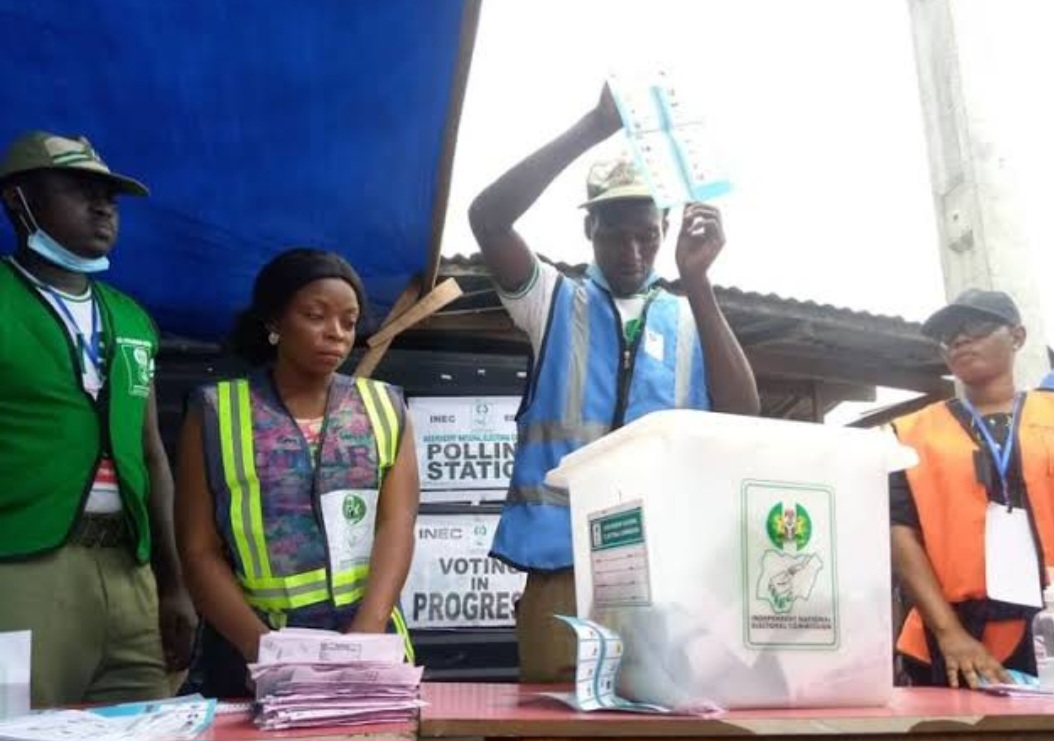
On Saturday, February 21 2026, a series of elections were held across the country. Two states, Rivers and Kano, had bye-elections to fill vacancies in the state constituencies, while the Federal Capital Territory of Abuja held its council election. The FCT Council election is the only the council election in the country conducted by the Independent National Electoral Commission (INEC). All other local council elections in the states are conducted by the state electoral commissions.
The two states that had bye-elections on Saturday, February 21, 2026, had two seats apiece to fill. The vacancies in Rivers State were in Ahoada II and Khana II constituencies while those in Kano were in Kano municipal and Ungogo Local Government.
Prior to the bye-elections, specifically on Thursday, February 12 2026, the INEC in Rivers State released details of the impending bye-elections. According to the Resident Electoral Commission, Gabriel Yomere who gave details of the bye-election, three of the main opposition parties; Peoples Democratic Party (PDP), Labour Party (LP) and African Democratic Party (ADC) would not participate in the bye-elections because they had been disqualified. What happened?
The official information had it that PDP, supposedly an opposition party, did not present a candidate because it was aligned to an arrangement that worked for the success of All Progressives Congress (APC).
LP could not field a candidate because of an intractable leadership crisis. ADC did not have a candidate because it failed to register within the stipulated timeframe for registering candidates. It seemed all too convenient.
That left the All Progressive Congress (APC) and six other odd political parties permitted to contest for the vacant positions in Rivers State. The other parties were Action Alliance (AA), All Peoples Movement (APM), Boot Party (BP), New Nigeria Peoples Party (NNPP), Young Progressives Party (YPP) and Zenith Labour Party (ZLP)
In the Kano bye-elections, three of the prominent opposition parties; Peoples Democratic Party (PDP), African Democratic Congress (ADC), and New Nigerian Peoples Party (NNPP) were all excluded. For one reason or another, the stronger opposition parties were not on the ballot. Even the NNPP, the Party of the incumbent governor until his recent deflection into APC, failed to qualify to be on the ballot. That left the APC with a clear coast to win every seat in sight.
By August 8 2026, Osun State will be going to the polls to elect a governor. That will be one of the two governorship elections in the country in 2026.
On Sunday, February 15,2026, INEC Osun State office issued a statement giving details of party standing for the governorship election. PDP and LP are disqualified. Again, an intractable leadership crisis was identified as the reason why PDP and LP will not contest the Osun governorship election. That leaves APC and thirteen others on the ballot.
The reality of a new political scenario in which key co-contestants are knocked out on technical ground before the actual contest commences appears, at best, dubious. Decapitating major opposition parties on the way to electoral contests leads to questionable elections, which in turn produce lame electoral victory. This new system is simply too shabby and farcical to subsist.
The judiciary is the culprit in all this. Forget about the political parties and party leaders that either do not obey their own rules or lend themselves to be procured to foist instability on their parties. The judiciary exists to contain such excesses and lawlessness that have made Nigeria’s political process a game for scoundrels. Sadly, the judiciary has taken a place in this ignoble scheme that may yet dislocate democracy in the country.
No other act or device by any individual or authority in the present political system has inflicted more damage on the cohesion within political parties than conflicting judicial pronouncements on leadership disputes. Yet these are problems the judiciary ought to resolve.
The involvement of the judiciary in political shenanigans aimed at destabilizing opposition parties, especially, counts among the most disappointment features of this regime.
It does appear at the moment, sadly, that the concept of independence of the judiciary has acquired a new twisted connotation in the judiciary itself. With courts of concurrent jurisdiction brazenly ignoring earlier pronouncements and order on same cases, many of the politically-exposed judges seem to be interpreting their independence to mean every court to itself and confusion for all. There is no report yet of sanction against these acts of judicial indiscipline.
More than any other reason, the PDP remains shackled by a leadership crisis because that is what the judiciary ordains. Also, at the LP, it was the courts that literally kept entertaining a closed case.
Even now that the Supreme Court has eventually put the LP matter to bed, there is no guarantee that the last has been heard of the matter.
Nobody will bet that before the party congresses, Mr. Julius Abure, the former chairman of the party, who appears to have a job to dislocate the party, will not approach a court, perhaps a magistrate court somewhere and be issued a judgment of sorts which INEC will comply with, thereby ensuring that LP is disqualified from presenting candidates.
There needs to be a stop to these rogue tendencies that characterize Nigeria’s political process at the moment. It is true that lack of honour does not disqualify in politics. but there are rules of the game. Eliminating co-contestants on the way to an electoral contest and emerging victorious in a non-contest is outright subversion of democracy. APC should prep itself to win properly. The judiciary on its part needs to extricate itself from the games politicians without honour play.
